-1.png "Starter - Blogger Template")
For Whom A Car Manual Is Written
For Whom A Car Manual Is Written - “whom” is a pronoun that functions as the object of a verb or preposition. But in more formal contexts and to be grammatically correct, that first who should be whom. Learn the key differences with simple rules and examples to master this common grammar challenge. We use whom to refer to people in formal styles or in writing, when the person is the object of the verb. Who is used to refer to the subject of a sentence or clause (the person performing an action). Do you know how to use who and whom correctly in a sentence?
But in more formal contexts and to be grammatically correct, that first who should be whom. Do you know how to use who and whom correctly in a sentence? Learn how to determine their use in this article. Who is used to refer to the subject of a sentence or clause (the person performing an action). Whom is used to refer to the object of a verb or preposition (the person being.
Who vs. Whom The Ultimate Guide to Nailing Your Grammar Game! ESLBUZZ

We don’t use it very often and we use it more commonly in writing than in speaking. Who refers to someone performing the action of a verb (e.g. They are the ones who sent me the gift), and whom refers to someone receiving the action of a verb (i'd like to thank the gift. But in more formal contexts and.
4 Relative Pronouns dalam Bahasa Inggris dan Contohnya

Who and whom are easy to confuse, but they are no different to he and him or they or them. Learn the key differences with simple rules and examples to master this common grammar challenge. Who is used to refer to the subject of a sentence or clause (the person performing an action). Who vs whom can be tricky! 'who'.
Who vs Whom Examples, Differences, Usage, Tricks, Tips
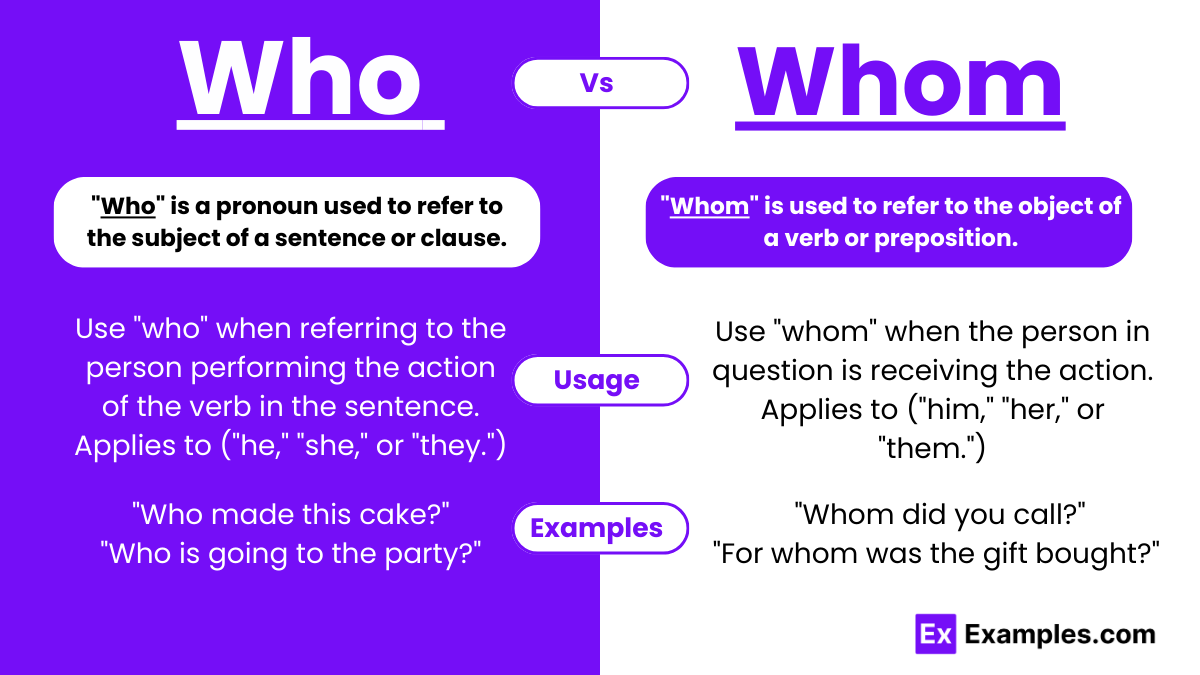
Use this they/them method to decide whether who or whom is correct. Below we share three tricks for how to figure out whether who or whom is correct. We use whom to refer to people in formal styles or in writing, when the person is the object of the verb. They are the ones who sent me the gift), and.
Who Vs. Whom Differences Uses And Examples Use Whom In A Subordinate

The main difference between who and whom is that who should refer to the subject of a sentence or clause, while whom is meant to refer to the object of a preposition or. But in more formal contexts and to be grammatically correct, that first who should be whom. Whom is used to refer to the object of a verb.
Who vs. Whom What's the Difference (With Table)
Who refers to someone performing the action of a verb (e.g. Learn how to determine their use in this article. Use this they/them method to decide whether who or whom is correct. The main difference between who and whom is that who should refer to the subject of a sentence or clause, while whom is meant to refer to the.
For Whom A Car Manual Is Written - But in more formal contexts and to be grammatically correct, that first who should be whom. We don’t use it very often and we use it more commonly in writing than in speaking. Below we share three tricks for how to figure out whether who or whom is correct. Who and whom are easy to confuse, but they are no different to he and him or they or them. 'whom' is an object (like 'him'). We use whom to refer to people in formal styles or in writing, when the person is the object of the verb.
'who' is the subject of a verb (like 'he'). Who is used to refer to the subject of a sentence or clause (the person performing an action). Learn the key differences with simple rules and examples to master this common grammar challenge. Do you know how to use who and whom correctly in a sentence? Learn how to determine their use in this article.
'Who' Is The Subject Of A Verb (Like 'He').
The main difference between who and whom is that who should refer to the subject of a sentence or clause, while whom is meant to refer to the object of a preposition or. Use this they/them method to decide whether who or whom is correct. We use whom to refer to people in formal styles or in writing, when the person is the object of the verb. We don’t use it very often and we use it more commonly in writing than in speaking.
Whom Is Never The Subject Of.
Learn the key differences with simple rules and examples to master this common grammar challenge. Below we share three tricks for how to figure out whether who or whom is correct. Do you know how to use who and whom correctly in a sentence? Who refers to someone performing the action of a verb (e.g.
Who And Whom Are Easy To Confuse, But They Are No Different To He And Him Or They Or Them.
Learn how to determine their use in this article. They are the ones who sent me the gift), and whom refers to someone receiving the action of a verb (i'd like to thank the gift. 'whom' is an object (like 'him'). But in more formal contexts and to be grammatically correct, that first who should be whom.
Whom Is Used To Refer To The Object Of A Verb Or Preposition (The Person Being.
Who vs whom can be tricky! “who” is a pronoun that functions as the subject of a sentence. Who is used to refer to the subject of a sentence or clause (the person performing an action). “whom” is a pronoun that functions as the object of a verb or preposition.